



 Takeaways
A few friends of mine who have been in crypto for years told me something that genuinely surprised me. We were talking about money, cashing out, and whether they had ever sent any of their crypto back to a bank account, and the answer was no, not even once. They were completely comfortable keeping money in wallets and moving it around the crypto world, but when it came to sending those funds back into the banking system, they had never done it.
The more I thought about it, the more understandable it seemed. Selling crypto is one thing, but getting that money safely into a bank account feels like a different step entirely, especially when larger amounts are involved, because that is when people start worrying about compliance checks, transfer delays, tax questions, and whether a simple mistake could turn into a bigger problem.
The first thing I told them is that, at least for now, you cannot send crypto straight to a bank account. Maybe in a few years banks will offer direct crypto custody and conversion as part of their regular services, but that is not how it works yet. Banks do not accept crypto directly, and they do not convert it into euros or US dollars for customers. If a crypto holder wants to convert their crypto to EUR and withdraw it to their bank account, they have to send it to a centralized exchange first. This is where a key series of events will happen, as these platforms have a license to accept crypto, convert it to any currency you prefer like Euro or Dollar, and transfer it to a regular bank. It may seem intimidating at first, but it becomes much easier once you understand how to withdraw from a crypto wallet to bank account? Create an account on a centralized exchange, verify your identity, deposit crypto to your exchange's wallet, go to the wires section, fill in your bank account details, and submit a transfer request. In most cases, the money will show up in your bank account within a few hours.
Starting the Transfer
Honestly, once you understand that banks do not accept crypto directly, the whole process starts to feel much clearer and a lot less intimidating. The main thing to keep in mind is that you need to move your funds through a third party that can work with both crypto and fiat, which in most cases means using a centralized exchange, so if you do not already have one, that is the first thing you will need to choose. Some of the most popular choices include Binance, Coinbase, Kraken, OKX, Bitfinex, and others. Still, the banking side does not suddenly become easier just because the exchange is bigger, since the same compliance rules and bank reviews can apply either way. What matters in real life is whether the platform gives you actual support, handles withdrawals properly, and can help you deal with issues if the bank asks questions or the transfer does not go through smoothly. Your exchange will act as a bridge between your crypto wallet and your bank account, allowing you to convert crypto to USD or EUR (or another supported currency) and transfer it like a regular bank wire.
But while learning how to withdraw from a crypto wallet to bank account, it’s good to know that centralized exchanges are not the only option out there. You can also choose one of the alternatives, such as P2P platforms and OTC brokers, and I will cover these in more detail later in this guide.
A Practical Guide to Withdrawing Crypto to a Bank Account
Moving funds from the crypto wallet to a bank account with PlasBit is effortless, even for the freshest of beginners. It takes exactly six steps to start the process, exchange crypto to fiat, and have the fiat land into the bank. Here is a step-by-step guide on how to use the bank wire feature on PlasBit.
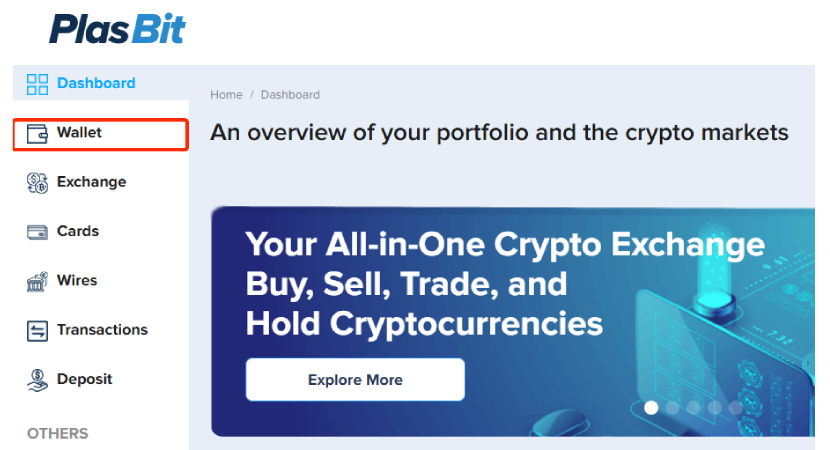
1. Log in and click on the ‘Wallet’ tab in the upper left corner.
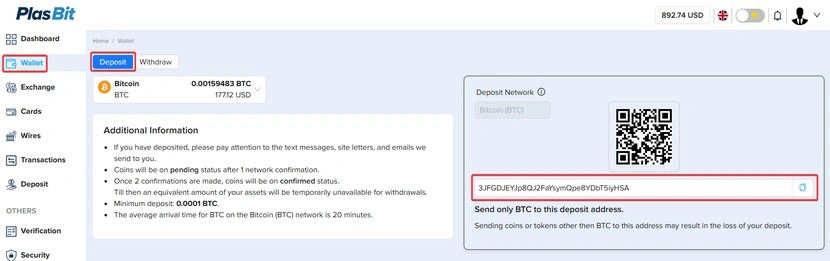
2. Deposit whatever crypto you want into your wallet.
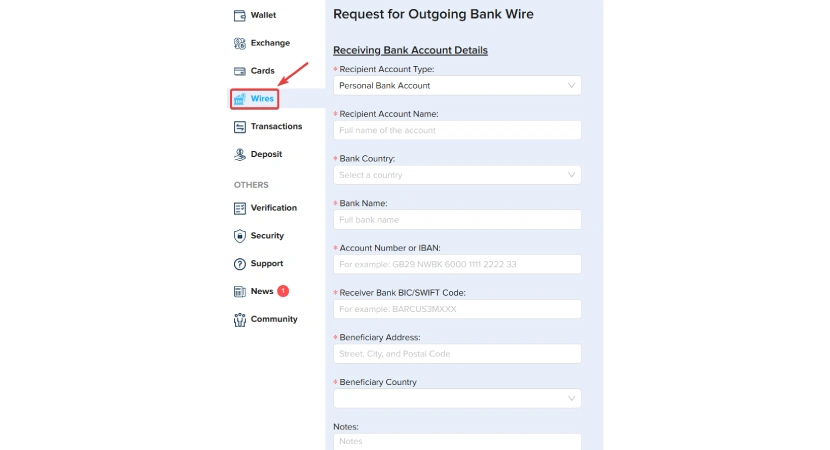
3. Click on the ‘Wires’ tab, and then fill in your bank details. Remember that the bank account name must match the name on the PlasBit account.
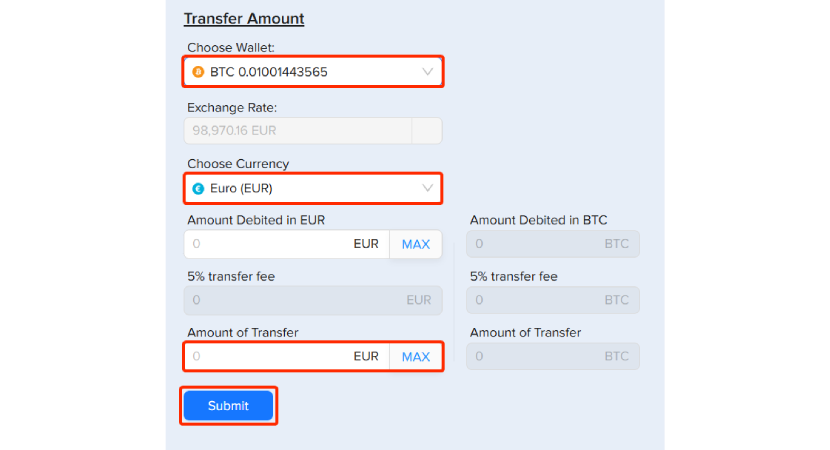
4. Choose the wallet which you want to charge and the currency you want to transfer to your bank, then enter the amount you wish to transfer, and hit ‘Submit.’
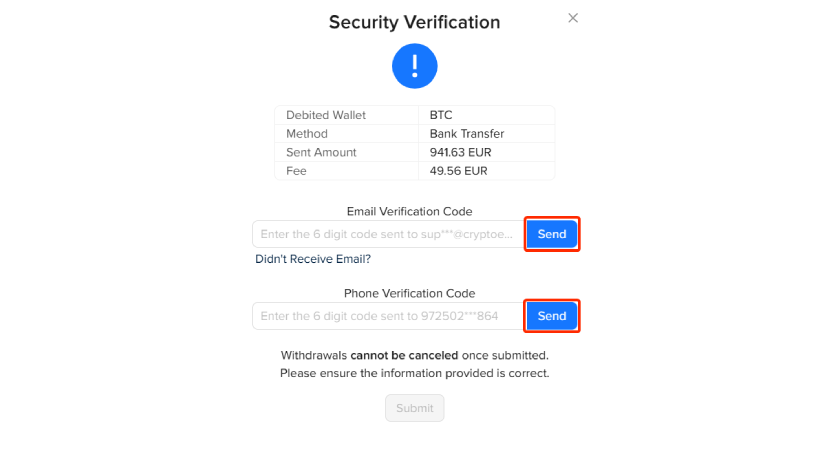
5. Click ‘Send,’ and you’ll receive verification codes to your email and phone to approve the transfer.
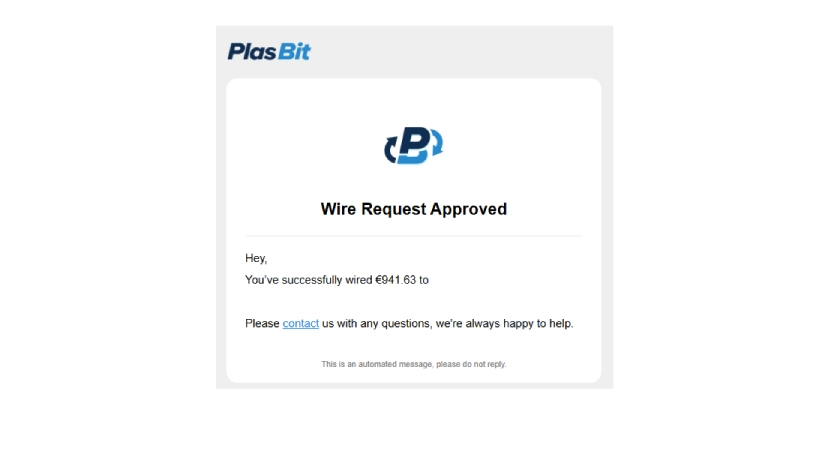
6. You will receive an email to notify you once your wire is approved.
7. You can check the status of your transfer in the ‘Transactions’ section by selecting ‘Wires Transaction’ from the drop-down menu.
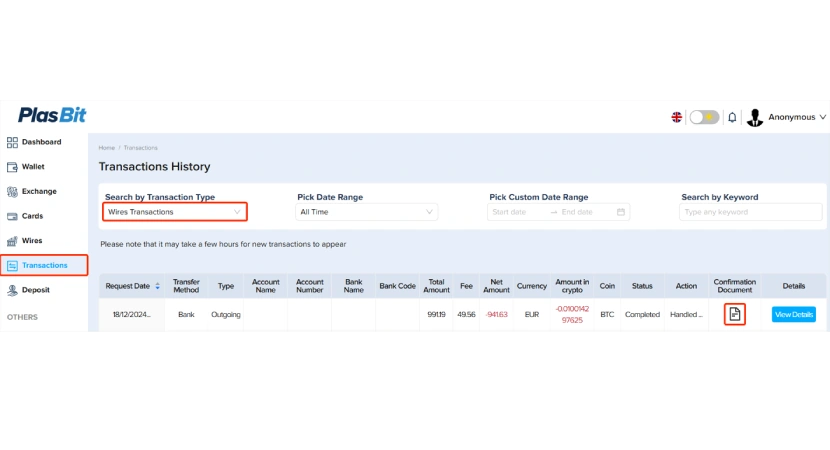
A super convenient option is that, once the transaction is approved, you can also download a PDF file with the transaction details.
Be It a Bank Or an Exchange, KYC Is a Must
Another key thing to understand is that completing KYC is a required part of converting crypto into fiat, especially in the European Union, because regulators require verifying every user to be verified through KYC, and crypto platforms can lose their licenses and, as a result, their access to the banking system if they fail to do it. It is a simple process, but some crypto users find it intrusive and contrary to the crypto values. KYC asks every user to:
- provide personal information (full name, date of birth, and address) to identify themselves;
- verify their identity with documents, such as an ID or a passport;
- complete facial recognition or biometric authentication;
- show a utility bill (for example, gas, phone, or electricity) for proof of address.
Some may even question why KYC is needed in the first place, but users need to understand that every person goes through the same process when they open a bank account, as well as when they sign up to a crypto exchange. To put it simply, regulators require every financial institution, whether a bank or an exchange, to identify each of its users.
Interestingly, a 2019 report found that 69% of crypto businesses did not have “complete and transparent” KYC procedures. Since then, compliance standards across the industry have tightened, but enforcing KYC has still been a challenge, to the point that some platforms chose to relocate to jurisdictions with softer KYC requirements. But this creates massive limits, because they can’t operate in most other countries. This is the reason why the largest and even the most unwilling crypto platforms decided to start introducing strict KYC measures, or they would face regulatory punishment and would have to stop operating in various regions. Despite their hesitancy, both crypto platforms and users acknowledge the benefits KYC brings:
- lowers malicious and illicit activity, as it doesn’t allow attackers, hackers, money launderers, and scammers to hide behind anonymous accounts;
- raises trust among customers and the general community;
- raises positive public image for crypto throughout the economy, which encourages wider adoption and boosts investment.
Banks Can Still Reject Your Crypto
Crypto has come a long way, and while today we know how to withdraw from a crypto wallet to bank account in a simple way, things weren’t always so easy. Actually, the first ever crypto transaction happened 17 years ago when, on October 12, 2009, New Liberty Standard bought 5.050 BTC from Sirius for just $5.02 through PayPal. Then, on May 22, 2010, now known as ‘Bitcoin Pizza Day,’ Laszlo Hanyecz from the USA paid a whopping 10,000 BTC for two pizzas. There were no exchanges at the time, and certainly no banks would come anywhere near BTC.
But then, people recognized the need for an entity that would facilitate crypto buying and selling. BitcoinMarket.com is considered to be the first crypto exchange, launching in March 2010, but the space exploded with the arrival of Mt. Gox in July 2010, as it became the dominant platform of the time. It, however, imploded four years later due to a series of security breaches. Then, Bitsamp became the first exchange in Europe in 2011, Kraken in the US in 2011, and Bitfinex in Asia in 2012.
And while the number of exchanges rose, just a few years back, no bank would even think of touching crypto. It’s true that many institutions globally are now more open to it, especially because they don’t actually work with crypto directly, but financial institutions’ acceptance is limited. Despite the undeniable rise in adoption, many banks still avoid accepting money connected to crypto and may cancel any transaction from an account linked to it, because they are required by law to verify and document the source of all funds. They must make sure the funds are not linked to criminal activities and that they were properly reported to the tax authorities.
This is a lot of work for little monetary reward. Basically, it’s not worth it for the bank because the cost and risk are too high compared to what they earn from the crypto-related business. But we have a solution. PlasBit has a finance department that knows the system inside out, that can teach you how to withdraw from a crypto wallet to bank account, tell you what documentation you need, and guide you through the process so that the bank gets all the information and documents they require. This way, they will not flag your transfer or block your account.
Why You Can Only Withdraw to Your Own Bank Account
Once you’ve chosen your exchange and your bank and completed the KYC process, you can withdraw your funds, but keep in mind that the bank account must be in the same name as the verified account you are withdrawing from, which means you cannot send the money to a third party’s account. For example, when John Smith opens an account on an exchange, that registered name ‘John Smith’ must match the name on the bank account. This rule is a part of the AML (anti-money laundering) laws and counter-terrorism financing (CTF) regulations, which exchanges must follow, designed to prevent scams and to stop people from using someone else's bank account to hide or launder money.
Also, if users want to withdraw amounts over €10,000 to their bank account, they need to provide a Source of Funds (SoF). These are documents that explain where the money comes from (e.g. salary, sale of assets, inheritance, gift, etc.) and also show the full financial trail leading to the crypto purchase. Exchanges use it to confirm that the funds are legitimate and not connected to illegal activity. For example, the platforms could ask for statements of crypto purchases on regulated exchanges, or any transfer from banks, other exchanges, and self-custody wallets, as well as transaction history. Next, users may need to provide documentation for over-the-counter (OTC) transactions, peer-to-peer (P2P) exchanges, or airdrops. Also, if the user was involved in trading, mining, or staking, they will need to provide proof of profits.
Platforms can also ask for employer or business income statements, a loan contract from a bank, or inheritance paperwork. Basically, they can ask for any relevant statement that would confirm that the crypto came from a legitimate source. If users do not provide a source of funds, the exchange can cancel the transaction, lock their account, or even freeze their funds.
PlasBit Never Locks Users Out of Their Accounts or Funds
Unlike other centralized exchanges, PlasBit does not deal with compliance issues by freezing funds or leaving users locked out without answers. When a case requires additional checks, users receive clear guidance and direct contact with a real person who walks them through the process, explains exactly what is required, and provides ongoing updates on how the case is being handled. If those requirements are still not met, including the source of funds where required, the funds are not processed, and the crypto is returned to the original sending address, after which the account is closed. This allows us to follow the laws and regulatory requirements that make our services possible while also ensuring that users remain in control of their crypto.
Learn How To Withdraw From DeFi Wallet To Bank
When comparing centralized and decentralized players, we’re talking about two entirely different beasts. Decentralized finance (DeFi) companies, including decentralized exchanges (DEXs), are unregulated, peer-to-peer, non-custodial, and permissionless. In simple terms, they typically allow users to trade anonymously without registration, meaning there is no KYC. You maintain full control over your funds, but the downside is that a DEX only supports crypto-to-crypto conversion and has no access to the banking system. To change your crypto into fiat and transfer it to a bank, you need to move into a regulated centralized exchange (CEXs), perform KYC and offer fiat on and off ramps, but they hold your private keys.
Therefore, even though some people choose to use decentralized options for their crypto, if they want to move their funds into a bank, they still need to go through a centralized entity that complies with KYC and AML. You’re probably asking then, how to withdraw from DeFi wallet to bank? Open an account in a centralized exchange, transfer the crypto from your DeFi wallet to your wallet on the exchange, then head to the wires section, enter your bank account details, and submit a transfer request. The money will often arrive in your bank account within a few hours.
Other Ways to Transfer Funds to Your Bank
Researching how to withdraw from a crypto wallet to bank account, I found that bank wires are the most common way to transfer funds. Generally, bank transfers are the preferred option for most users because it is a standard and direct way to transfer crypto to a bank account. However, there are other ways to convert crypto to fiat or transfer it to your bank, and these methods give users additional ways to access or transfer their funds after converting crypto to fiat. Let’s take a look at a couple of them.
Peer-to-peer (P2P) transactions allow people to connect with each other, for example, through a platform, where a buyer pays with fiat and transfers the funds straight to the seller’s bank account. This allows both of them to bypass centralized authorities as intermediaries. But trust is crucial here, because the seller could be scammed out of their crypto. There’s also the option for the seller’s crypto to stay in an escrow account until the payment is received, but this also requires the involvement of a centralized entity, so it stops being pure P2P.
Over-the-counter (OTC) crypto trading also removes crypto exchanges from the picture. Instead, an OTC desk facilitates private, direct trades between two parties, typically institutions. Like P2P, the seller and the buyer agree on a price (P2P at the time of trade, and OTC in advance), and unlike P2P, the OTC option is more suitable for large-volume trades.
How to Withdraw From MetaMask to Bank Account?
MetaMask is one of the world’s most popular crypto wallets, and if you haven’t used it yourself, you definitely know people who have. This option also requires you to open an account on a centralized exchange if you don’t have one, but otherwise, even with that additional step, the process is fairly quick and simple. So, how to withdraw from MetaMask to bank account? First, go into your MetaMask wallet and transfer the crypto to your wallet on a centralized exchange, then head to the ‘Wires’ section, enter your bank account details, and submit a transfer request. Usually, the money will appear in your bank account within a few hours.
CEX and KYC Are Unavoidable
Once we understand how to withdraw from a crypto wallet to bank account, we also understand that it’s not a complicated process, but it does require a lot of personal information, which some users do not appreciate. However, you have to use a regulated CEX and complete a full KYC verification for the banks to even consider the transfer. Make sure that you’re fully verified, that the bank account name matches the exchange account name, and that you have the necessary documents to prove the source of your crypto. When you prepare all this at once, it will be much faster to move the funds in the future. If you have any questions or need personal help, you can always reach out to our support team and a real person will guide you through the process, help you understand what is needed, and give you clear answers along the way.