




 Takeaways
Have you ever received a DM from a “well-known investor” offering their expertise that will make you a millionaire? I can’t even begin to tell you how many times bad actors tried to steal my crypto, and some were dangerously convincing. I was lucky that some of today’s most sophisticated scams weren’t a thing when I was an inexperienced investor, a noob. Crypto is quite tempting to scammers for two key reasons: it offers relative anonymity, because we see only the wallet transacting on the blockchain, not personal details, and two, there are tools to scramble transactions like an egg, making them a huge headache to trace and giving the thieves time to vanish. Once you hit that send button, there is no taking it back, as you’d need the receiver to send the funds back to you, and they certainly won’t do it.
But that’s not even the end of this sad story because the scammers are still on the grift, working their mark further. People who get scammed are understandably desperate to find any help to recover their funds. But like putting salt on an open wound, fraudsters will use that distress to scam the victims again, often promising the impossible, a way to get the sent crypto back. So after the fall for a scam victims often ask themselfs, can you recover crypto from a scammer? No, crypto transactions are irreversible, however since crypto operates on a public blockchain, you can use websites that track blockchain transactions to see where the scammer sent your crypto, and if you notice that it reached a centralized exchange, contact the exchange through their law enforcement form so they can freeze the funds. Make sure to report the scam and include the report when contacting them, as exchanges need an official document before they can lock the funds and return them to you. But keep in mind that skilled scammers often use mixers to cover the transaction trail, making it impossible to trace the crypto. In most cases you end up losing more funds and you won't recover anything. To put it simply, don’t ever trust anyone without extensive research.
If You Get Scammed, These Are the First Steps to Take
Most of us have read numerous stories about people getting tricked, the many ways in which they’ve been defrauded, and their struggle to get the funds back. We tend to think that something like that can’t happen to us, but we’re all vulnerable as frauds evolve and only in 2025, a whopping $17 billion was stolen by scammers. These scams can happen in a single move or play out over weeks and even months, but the longer ones are usually worse because the scammer has more time to build trust, lower the victim’s guard, and slowly drain and suck them dry. In most cases, the stolen crypto is gone for good, but there are still a few situations where recovery may be possible.
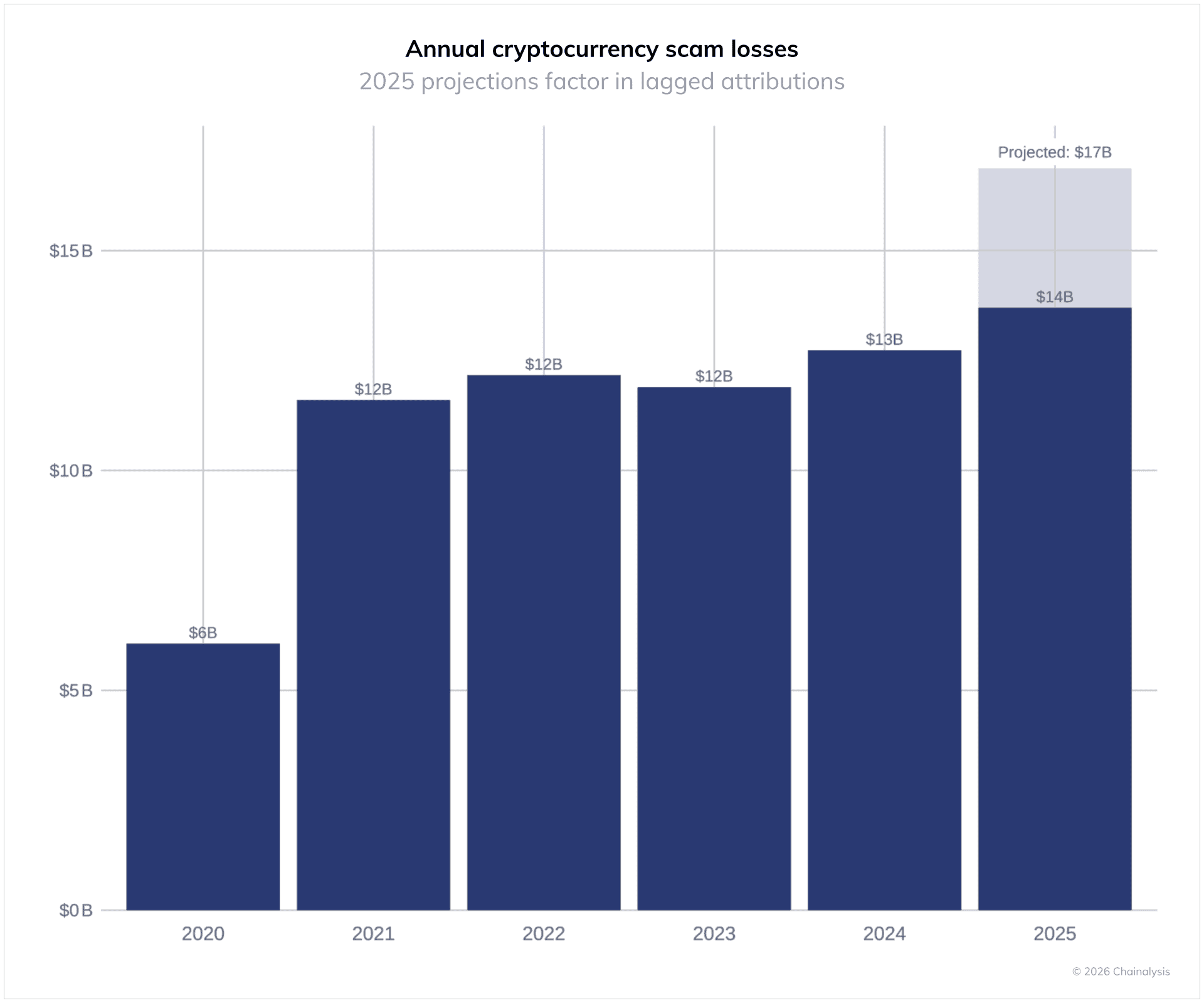
Source: Chainalysis, Record $17 Billion Estimated Stolen in Crypto Scams and Fraud in 2025 as Impersonation Tactics and AI Enablement Surge
We prepared a guide to answer the question of can you recover crypto from a scammer, with practical steps victims can take:
Step 1: Report
Your very first action is to document everything, save all evidence, and report the scam to your local law enforcement right away. Tell the authorities how you were defrauded, that you sent your crypto to a wallet controlled by a scammer, and show them any proof you have, such as communication with the fraudsters, wallet addresses, and transactions. Don’t wait, and make sure you have that official report at hand for further steps, such as sending it to a centralized exchange whenever possible. Also, if your credit card was involved in any part of the scam, report it to your bank as well.
Step 2: Track
Try to track your crypto on blockchain explorers to see where exactly it ended up. We mentioned earlier that crypto is relatively anonymous, which means not completely. Everything happens on a blockchain, with every single transaction being recorded transparently, for all to see. Even though we don’t know who the address belongs to, we can track which address holds the funds. Tracking can get quite frustrating as scammers keep splitting the stolen crypto across different wallets to different addresses. To start tracking, you’ll need to enter a wallet address or transaction ID on the website that matches the blockchain your crypto was on.
- blockchain.com to track stolen funds on the bitcoin network
- etherscan.io to track stolen funds on the ethereum network
- tronscan.org to track stolen funds on the tron network
- solscan.io to track stolen funds on the solana network
Step 3: Freeze
One of the reasons to track the crypto is to hopefully catch it on a centralized exchange. If the stolen crypto ends up on a centralized exchange, this could be a golden opportunity to recover it. You can contact the exchange, submit the official report you received from the police or other law enforcement agencies, and request a freeze of funds. The exchange has the authority to freeze the account and help law enforcement, because all the users must complete KYC and provide personal information to have an account.
Here are a few contact examples:
- If your crypto was sent to Binance, contact the exchange via the Law Enforcement Requests page.
- If it’s on Coinbase, send an email to subpoenas@coinbase.com
- If the scammers used Bybit, fill the form on the platform’s law enforcement page.
Keep in mind, though, that scammers work hard to hide their transaction trails, and the most experienced among them will be well-versed in using mixers (tumblers) and other privacy tools to launder the crypto and cover their tracks so there is a chance but you need to report it as soon as possible before they can withdraw the crypto out of the exchange.
Do Not Fall For Crypto Recovery Scams
Scammers are vicious and will try to take everything they can from their victims. Some of them specifically go after people who have already been scammed, knowing they are desperate, vulnerable, and more likely to believe anyone promising they can help recover the stolen crypto. These scammers are usually associated with the original ones, and in some cases they are the exact same people, just pretending to be someone else. Many scammers are a part of a bigger operation and will share victims’ details either amongst themselves or sell them to a different organization, often on the dark web, hoping to squeeze more money out of their marks, even if it means making them borrow money, use their savings, or sell anything and everything of value. And as you try to figure out can you recover crypto from a scammer, you get conned again, losing even more than your initial investment. The lesson here is that we should never make impulse decisions, no matter how desperate we get, and to do thorough research before paying for any recovery service so as not to fall victim a second time.
PlasBit has seen it all, and we want to help people protect their crypto. One way is by showing how scams work so you can understand what's going on behind the scenes and not fall for it. If you were scammed out of crypto, somebody may contact you, claiming that they can return it if you just pay the recovery fee or even worse, they can claim to be law enforcement. You’re too distressed to recognize the red flags as you normally would, and scammers will not appear without “proof,” likely providing a wallet address, which they themselves control, with funds in it, claiming it’s yours. But in order to return the crypto, you have to pay a fee upfront, typically a transaction fee, taxes, or legal costs, and you need to do it right away, no time to wait or think, or “the crypto will be gone forever.” Even if you do pay, they’ll continue to relentlessly pressure you to pay more and more until you refuse to pay or have nothing else to give, which is a cue for the scammers to disappear.
There Are More Ways to Steal Crypto Than You Can Imagine
It’s the scammers’ job to think of new ways to fool us, while there’s always only one answer to can you recover crypto from a scammer. But instead of imagining all that can happen, it’s better to be aware of the most prevalent methods fraudsters have used for several years now. And one of these is the infamous rug pull, one of the easiest to fall for.
There’s a ridiculous number of ways for scammers to steal crypto, including:
- Ransomware
- Catfishing
- Pig Butchering Schemes
- Phishing Attempts
- Romance Scams
- Fake Token Presales
- Fake Analysts offering tips to help you generate profit
- Exit Scams (aka rug pulls)
- Drainware (Fake websites, exchanges, apps designed to steal wallet details)
- Fake Giveaways And Airdrops
- Pump And Dump Schemes
Investors are constantly searching for the “next Bitcoin”, and too many inexperienced ones just ape in, invest a lot and fast with little to no research, and start immediately asking “when Lambo,” waiting for that much-promised wealth to buy a Lamborghini. They want a winning crypto that will moon, surge from nearly worthless to changing hands for hundreds or thousands of dollars apiece. And scammers use this desire to get rich quick. They’ll create a coin, perhaps even a whitepaper and a team, and they’ll form a massive media presence to boost their credibility and shill their coin. This person or group will keep or buy the majority of their token supply for themselves (a gigantic red flag), while genuine investors buy the rest. As more is bought, the demand does its thing, and the price grows, creating the FOMO (fear of missing out) effect, pulling more investors into the scam, until the price balloons from, let’s say, $0.001 to $30. And then, the scammers pull the rug from underneath the investors, sell their own holdings for $30 a coin, earn a fortune, and vanish, leaving the investors holding the bag of now worthless tokens as the price plummets.
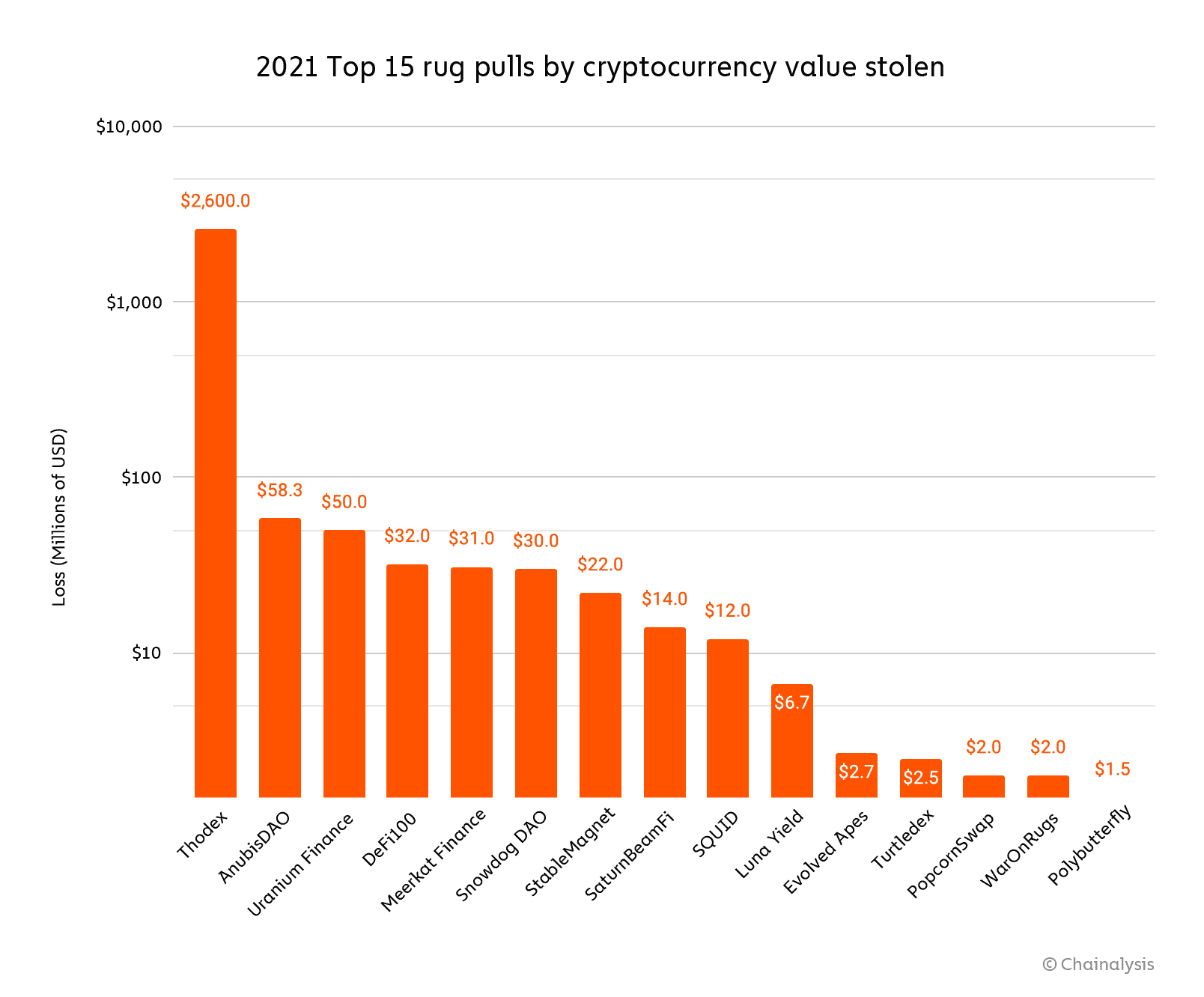
Source: Chainalysis, The Biggest Threat to Trust in Cryptocurrency: Rug Pulls Put 2021 Cryptocurrency Scam Revenue Close to All-time Highs
Nearly $3 billion in crypto was rugpulled in 2021 alone. Here’s a real-world example from that year, a typical case of a token sale in combination with a rug pull. AnubisDAO, a decentralized autonomous organization (DAO), raised $60 million in Ethereum by selling its token. The project generated enormous hype on social media with just a logo and nothing to back up their claims, creating FOMO and pushing the price higher. Just twenty hours after the sale ended, the scammers pulled the funds from the DAO’s liquidity pool and sent it to several addresses, employing mixers along the way. The token’s value dropped to zero.
People behind rug pulls can be anyone. A 2025 National Geographic documentary interviewed three scammers in their 20s, each with a specific role in their well-oiled conning machine. The one going by “Mr. X” does his homework regularly, even visits expos to learn all about the latest security features and protocols to avoid in his criminal endeavor. The second person, “Shiller,” heavily promotes the fake token on social media, gathering supporters, and the third, “Washer,” launders the illicit gains by chopping them up into smaller and smaller transactions sent to different wallets.

“Mr X”. Source: Crypto Scams, Trafficked with Mariana Van Zeller, National Geographic, YouTube
The stolen funds continue being laundered after they’ve left the onchain world, as thieves commonly buy luxury items, typically cars, fashion articles, real estate, and jewelry. Each of the three involved in the $60 million scam lives a life of opulence. And yet, these and many other scammers don’t think of themselves as thieves, calling rug pulls “a legal way of stealing.” They blame the victims for being “stupid” and not doing even five minutes of research before sinking their money into a project.
How to Recover Money From a Crypto Scam?
You may do everything right a hundred times, but then you make one wrong move, and your funds are suddenly sitting in a scammer’s wallet, soon to vanish forever. But is that the end? Do you know how to recover money from a crypto scam? Report the scam to law enforcement and save any proof you have, like wallet addresses and contact information. Then track your crypto using websites like blockchain.com, and if you find that the crypto is transferred to a centralized exchange, contact the exchange so they will freeze the funds. However, if the funds weren't sent to a centralized exchange and the scammers used mixers to hide the crypto trail, it's impossible to recover the crypto.
However, the first goal should always be to do everything you possibly can to avoid going from a target to a mark to a victim. We at PlasBit advise our users to get familiar with, at the very least, the most common scam types, and one of these is fake websites. The website scam is particularly tricky because they are made to look very real, nearly indistinguishable from genuine and existing businesses, promising all sorts of crypto services. But their only goal is to get your funds and your personal information, including credit card numbers and crypto wallet data. They can be hard to recognize, but there are some simple tells to keep an eye out for. First, always check for typosquatting: how the domain name is written, are there misspellings krakan[.]com, extra characters coinbase1[.]com, or uncommon extensions binance[.]abc. Speaking of websites, most use encryption, so avoid any that don’t start with https:// because something is fishy there.
Make sure to google everything and do it thoroughly to see if other people have reported suspicious activity. Avoid sites with no reviews or clearly fake, overly enthusiastic reviews, and dubious celebrity endorsements. See whether they’re promising unrealistic or vague goals. Click on different pages, look for poor web design, spelling mistakes, and missing (contact) details. You can check the team page and google each individual, and sometimes you’ll find obviously fake names. With the rise of AI, faking an image is easy now, but you can verify that as well.
Additionally, real companies will not rush you into a decision and put pressure on you about “limited” and “one-time only” events that offer a whole BTC for $1 if you would just hurry up and pay only the legal costs to unlock “your BTC.” Real websites will not be posting guaranteed profits either, because nobody in the world can promise you any gains. And finally, no legitimate business, white hat, or detective will ask you for an upfront fee of any kind to help you recover stolen crypto.
Is It Possible to Recover Stolen Crypto?
The scammers will keep finding ways to steal crypto, which means that there will continue to be victims as well. Once those funds are out of your wallet, the situation may seem hopeless, but is it possible to recover stolen crypto? Yes, use websites that show blockchain transactions to track the scammer's address, and if you notice that your crypto was transferred to a centralized exchange, contact the exchange and ask them to freeze the funds. Make sure to report the scam to law enforcement, as exchanges need an official report before they can freeze the funds and return them.
Can I Get My Crypto Back If I Got Scammed?
Though the victims may feel lonely in their battle to recover the funds, institutions like centralized exchanges and law enforcement can help when you’re faced with the tough question of can I get my crypto back if I got scammed? No, crypto transactions can't be canceled, but you can use websites that track blockchain activity to follow the scammer’s wallet, and if you find that your crypto was sent to a centralized exchange, contact the exchange through their law enforcement contact form and report the scam to the authorities so the exchange can freeze the funds. Exchanges require an official report to freeze funds and send them back to the victim.
Conclusion
When it comes to getting scammed, our best hope is that we never do. Each of us can work on it by actively researching how to protect ourselves, reading guides like this one, learning to recognize different types of scams, and using only reputable websites and trusted platforms like PlasBit. The most basic thing we can do is simply not trust anyone and anything without first doing extensive research, and we definitely shouldn’t get swept up in FOMO and promises of moons and Lambos. Because once that crypto is gone, it’s gone, and there is no method to reverse the transaction. In that case, the best course of action is to report the scam to the authorities, get the official report, follow the crypto, and hope it landed on a centralized exchange that can freeze the scammers’ account. No matter what happens, never make an impulsive decision driven by anxiety, which may open doors for further scams. You want that door firmly shut forever.