




 Takeaways
In a meeting last week, an affiliate marketer told me she was spending far more time dealing with payment issues than actually improving the company’s campaigns. She can't pay for all the campaigns she is running unless she can get several plastic cards, but the banks restrict the number of cards they issue per person. Every new ad account, an additional platform, a team member, or even a slight budget change would add an extra layer of complexity to her task. Moreover, she tells me that affiliate marketing is not just creating one campaign and letting it run; she always needs to manage multiple campaigns at the same time. Virtual cards break all these obstacles: they are a lot easier and cheaper to use, and she can get as many of them as she needs. It's a payment solution that provides more flexibility and organization, but also offers greater control over advertising spend.
So now that my friend understands virtual cards can help her run several campaigns, she asked me, can I use virtual cards for advertising? Yes, you can use virtual cards for advertising because they work just like regular debit cards, where you get the card details online and add them as your payment method on platforms like Google Ads, Facebook Ads, or X to pay for your campaigns. There are also virtual cards that can be loaded with crypto, the preferred payment method for affiliates.
In this guide, we’ll look at an option that has become super popular among marketers because it makes campaign management so much simpler.
Things to Consider Before Using Virtual Cards for Advertising
If you’re wondering, "Can I use virtual cards for advertising, you’ll quickly learn that virtual cards offer numerous advantages for affiliate marketers, but there are a few practical details to understand before you start using them.
Every virtual card has a base currency, so a card denominated in euros (EUR) means you load euros onto the card, and the balance is held in that currency. If you pay for something in a different currency with that card, such as US dollars (USD), you will incur an additional 2% foreign exchange (FX) fee. Keep in mind that this fee is not the same as a card loading fee, which is separately charged when you add funds to your card.
It’s also important to remember that not all virtual cards are available in every country worldwide, so when you’re choosing a provider, check to see if their services can be used both in the country you live in and where your business operates.
Finally, because some countries are under international sanctions, cross-border payments can be easily blocked. Local banking rules in different jurisdictions can also limit how virtual cards are issued or used there. This means that some transactions may be declined even if there are sufficient funds on the card.
Advantages of Virtual Debit Cards for Affiliate Marketing
Looking into the question of whether you can use virtual cards for advertising, you’ll find that, unlike traditional credit or corporate cards, virtual debit cards offer massive advantages for affiliates.
Better Budget Control for Every Campaign
One of the biggest advantages of virtual debit cards is the ability to create a separate card for each campaign and load each one with a specific amount to match each specific campaign’s budget. This means you can never spend more than you planned, preventing accidental overspending. For example, if an affiliate marketer has $2,000 to test a new offer, they can create a virtual card and load it with this exact amount, instead of using a card with a much higher spending limit. Even if costs suddenly jump, spending will never go over that $2,000 limit.
Faster Access to Additional Funds
Speed is super important when a successful campaign needs more money. With a virtual card, you can reload it online within minutes, 24/7, instead of lining up at a physical location during work hours. For example, your campaign could start seeing fantastic results on a Saturday evening and quickly use the budget. No problem: load up the card online right away so the campaign continues to run uninterrupted, instead of pausing everything until you can get to a loading location on Monday morning, or having to make long phone calls and waiting for the banks’ approval.
Higher Limits Reduce Campaign Disruptions
Virtual card providers offer high spending limits, so that affiliates who manage large advertising budgets don’t need to worry about their campaigns suddenly stopping because a card has maxed out. For example, an affiliate marketer is scaling a highly profitable campaign across several countries and decides to raise the ad spend significantly. Because the card has higher limits, there’s no need for numerous payment adjustments, and campaigns continue running smoothly.
Easier Expense Tracking Across Clients and Platforms
Because these cards are virtual, you can issue as many as you want to, using one card per client or campaign, or even one card for each platform the client wants to advertise on. This makes the entire process very organized, as it’s easy to track each campaign's budget for every single client on each platform. For example, if a marketing agency manages campaigns for several clients across Google Ads, Facebook Ads, and X, they can assign separate virtual cards to each client and/or platform and instantly see where money is being spent without sorting through hundreds of transactions mixed together on one card statement.
Reduced Financial Risk If Card Details Are Compromised
Virtual debit cards only carry the balance that you’ve loaded onto them, so even if it somehow gets compromised, the potential losses are limited to these funds only. This is different from traditional credit cards, where unauthorized transactions could eat up a much larger spending limit before being detected. For example, if an affiliate marketer uses a virtual card loaded with $500 for a small test campaign, but the card details somehow get exposed, the losses would be limited to those $500, not the full spending limit of a corporate credit card.
Instant Card Creation Without Physical Delivery
Virtual cards exist entirely online, so they’re issued quickly and can be used immediately, as soon as you load them. For example, a marketer may need a new payment method for a campaign that’s launching later the same day. There’s no need to ask for a new card, visit a branch, wait days for a physical card to arrive by post, then manage all those cards around the office. They create as many virtual cards as needed online, receive the card details, and begin setting up their advertising account within minutes.
Four Steps To a PlasBit Virtual Card
If you’d like to use virtual cards for advertising, you can buy one or more PlasBit virtual cards in a few straightforward steps. It’s a simple and intuitive process.
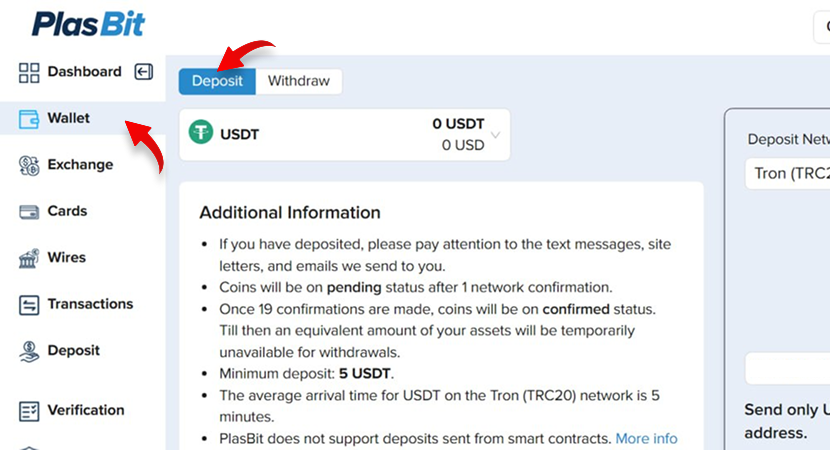
1. Login to your dashboard and go to the wallet section to deposit your preferred crypto.
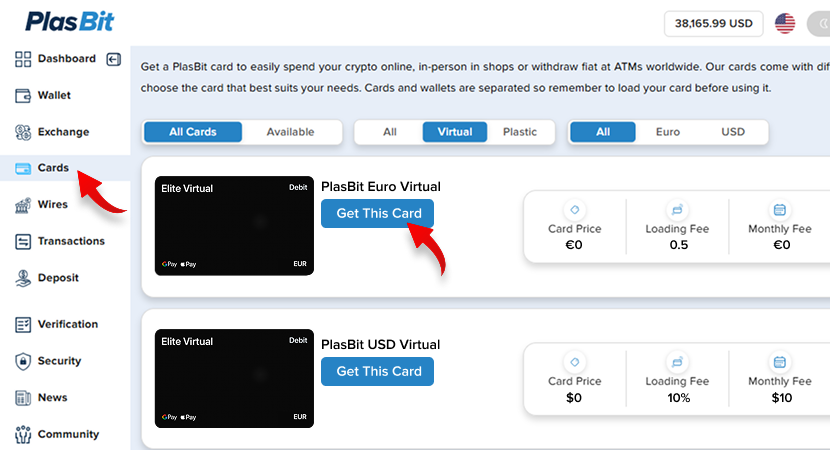
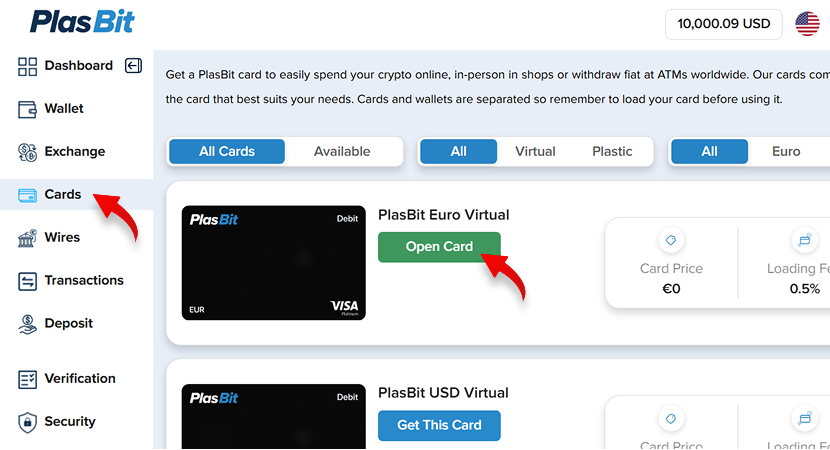
2. Go to the cards section and select the card, and click "Get This Card" button.
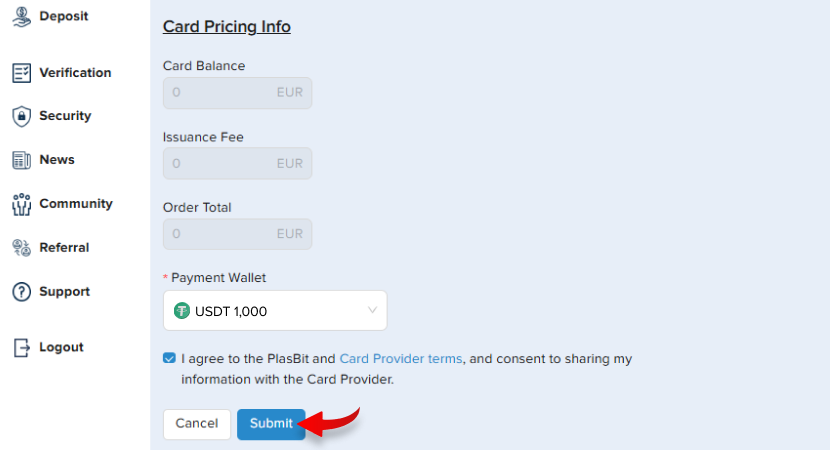
3. Confirm your order and wait for the card order confirmation.
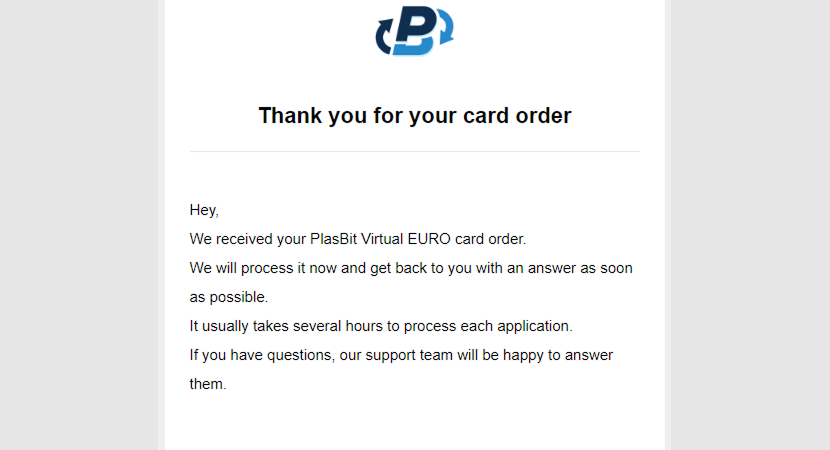
4. Once your card has been successfully issued, you will receive a notification via email.
5. Then go to the "Cards" section, click "Open Details" on your PlasBit Card.
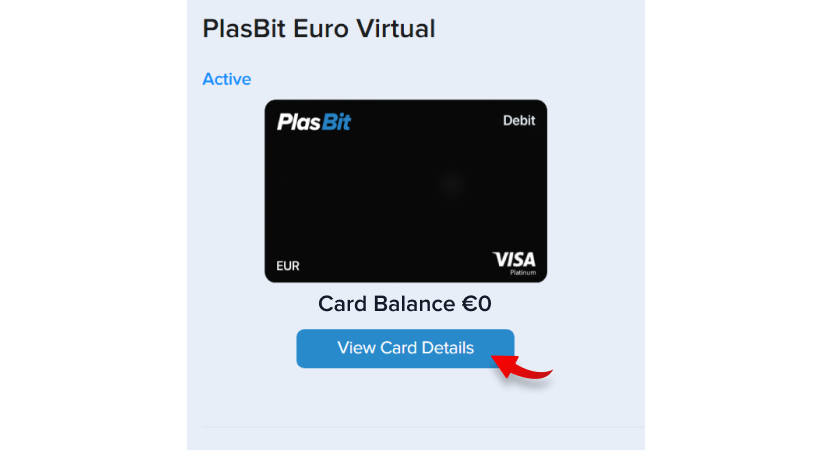
6. To get your card details, press the View Card Details button and enter the code that was sent via email. Then you will be able to see your card number, expiry date, and CVV.
7. In order to use the card, you first need to load balance onto it. Go to the "Funding" tab and choose the wallet you wish to charge, in this case, USDT. Next, enter the amount you want to load and press "Load".
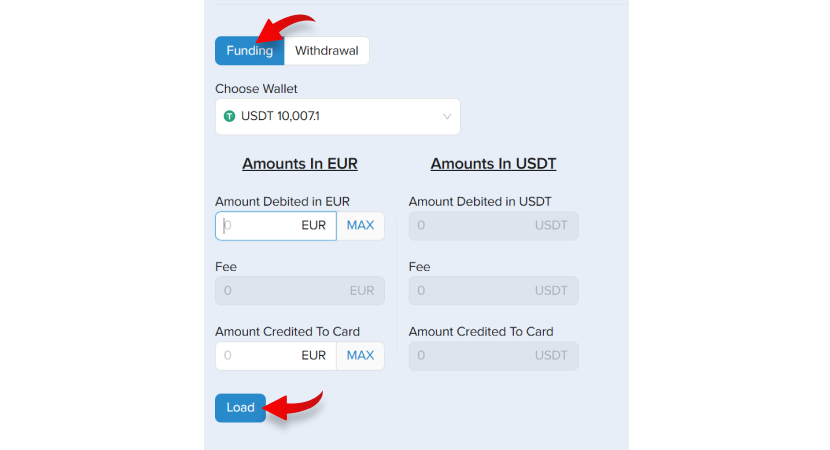
That's it, your card is all set and you can connect it to any advertising platform you’d like because there is no difference between this payment method and any other bank card.
Major Obstacles Advertisers Must Jump Over
Affiliate advertisers face several key issues when they pay for online ads with credit or corporate cards.
Card Limits Can Interrupt Active Campaigns
One of the most common problems is hitting the card’s spending limit. Advertising budgets tend to scale fast, especially when a campaign is seeing a great response, and then the card hits its maximum limit sooner than expected. What then? Well, ad platforms could stop running those well-performing campaigns until they have a valid payment method. But this easily means lost traffic and revenue.
For example, when an affiliate marketer runs a profitable campaign and decides to increase daily spending to capitalize on those great results, the card hits its budget ceiling just days later, and the ads stop. Now, the marketer has two choices: wait for the limit to reset or get another card. In the case of prepaid cards loaded with cash, they must go to a physical location (e.g. post/exchange office or retail location), stand in line, and spend valuable time reloading the card before campaigns can start again. To get a new card, they need to wait for it to be issued. Either way, by the time they finally have the funds, the campaign’s momentum may be lost.
To avoid this, use dedicated virtual cards that can be reloaded online within minutes. You’ll be able to continue running campaigns without any significant interruptions.
Sharing One Card Across Multiple Campaigns Creates Management Problems
Many affiliate marketers run several campaigns at the same time, and often across different platforms or client accounts. Using just one card for all of these advertising expenses can make it really difficult to track spending for each campaign. For example, an affiliate marketer is running campaigns on Google Ads, Facebook Ads, and X, but at the end of the month, the card statement arrives with dozens of charges, all mixed together. It will take hours to figure out which costs belong to which campaign and what the actual profitability of each one is.
It’s best to use separate virtual cards for each campaign, client, and/or platform so you can easily track all advertising expenses.
Bank Security Checks Can Pause Campaign Spending
Advertising platforms process payments, transactions, and budget increases from different accounts. However, traditional banks could see this as unusual activity, resulting in a temporary card until the cardholder verifies the transactions. For example, if an affiliate marketer launches several new campaigns over the weekend and raises budgets after seeing good results, the bank's fraud detection system could flag the activity and freeze the card. And it’s the weekend, so no customer support is available until business hours. The campaigns must stop running, which will impact future performance and revenue.
Have different cards dedicated specifically to advertising activity to maintain control over campaign payments. This will also prevent delays and interruptions.
Team Access Can Be Difficult to Manage
As affiliate operations grow, various team members will likely need to access the advertising budgets. But sharing a single physical card among several employees introduces unnecessary complexity. Spending becomes more difficult to control, and security concerns grow exponentially, disrupting the entire team. For example, a marketing agency has several media buyers who manage different campaigns, and everyone uses a single card, instead of giving each buyer a separate payment method. It becomes very difficult to identify who made each charge, especially unexpected ones.
As you can have as many virtual cards as you need, issue separate cards to individual team members, clients, or campaigns.
Can I Pay With Virtual Cards for TikTok Ads?
TikTok is one of the most popular advertising platforms thanks to its massive, highly responsive audience and its highly targeted ad formats. Before you launch a campaign on this video giant, you'll need a payment method that TikTok accepts, but also one that allows you to manage your advertising budget in the most efficient way possible. This naturally raises the question, can I pay with virtual cards for TikTok Ads? Yes, you can. Virtual cards are an accepted payment method on TikTok, just like any other debit card. You can order a virtual card online, fund it with your preferred method, and add the card's details as a payment method on TikTok to run your ad campaigns.
Can I Use Virtual Cards on Facebook Ads?
The competition is surging, but Facebook is still one of the most popular advertising platforms among affiliate marketers. It gives you access to 3 billion monthly active users, as well as detailed audience targeting options. Once profitable, Facebook campaigns can be scaled quickly, which is why marketers need payment methods that can keep pace with potentially rising ad spend without halting the campaign and ruining its performance. Can I use virtual Cards on Facebook Ads? Yes, you can. Virtual cards work just like regular debit cards and can be used to pay for Facebook Ads, and they are an accepted payment method on Facebook. Just order a card online, load it by making a bank transfer, or even use crypto, which is the preferred method by affiliates to pay for online ad campaigns.
Can I Pay With Virtual Cards on Google Ads?
As all affiliate marketers know, Google Ads is a major source of traffic and one of the most important advertising platforms available. However, it also comes with strict payment requirements, significantly more so than many other key platforms. This is why marketers are increasingly looking into the option of using virtual cards to fund their campaigns, instead of (completely) relying on traditional payment methods. So, can I pay with virtual Cards on Google Ads? No, Google Ads does not accept virtual cards as a payment method; however, if you register your Google Ads account in the United States, China, Australia, or the Philippines, you can still use a virtual card by connecting it to a PayPal account and using PayPal as your payment method for Google Ads because Google only accepts people in these specific countries.
Combining PayPal and Virtual Cards for Google Ads
So, how can you use virtual cards to pay for Google Ads with PayPal? One key limitation affiliate marketers should be aware of is that Google Ads doesn’t accept virtual cards as a direct payment method. The thing is that over the years, bad actors have used virtual cards associated with various forms of payment abuse and fraudulent advertising. Google made its payment controls stricter than many other advertising platforms and started rejecting virtual cards when they are used as a payment method on a Google Ads account.
But this doesn’t mean you can’t use virtual cards for Google advertising, as there are simple workarounds. Google Ads supports PayPal as a payment method in several countries, so if your Google Ads account is registered in the United States, the Philippines, China, or Australia, you can connect your virtual card to a PayPal account and then choose PayPal as your payment method for Google Ads. Thanks to this method, PayPal becomes a sort of intermediary that enables you to sidestep this restriction.
Overall, before you launch a campaign anywhere, take some time to double-check which payment methods you can use. This is especially important because Google Ads payment options can change suddenly, and you may not be aware of it. If you need a handy summary of Google Ads payment methods for each country, check out this guide.
Conclusion
Now that you know you can use virtual cards for advertising, make sure you choose a provider that makes it easy to create and manage multiple virtual cards across different campaigns. PlasBit virtual cards allow you to seamlessly create separate cards for different campaigns, clients, and advertising platforms. It helps keep spending organized, so you always know exactly where the money is going, what it’s for, how much, and who’s paying. The limit is always the amount of money loaded onto each card and not a cent more.
Cards can be issued instantly and reloaded online at any time, which means you can react quickly when a campaign needs additional budget without waiting for bank approvals or visiting a physical location. The ability to fund cards with crypto also offers a convenient option for affiliates already operating in the crypto ecosystem. Combined with reduced exposure if card details are compromised and the convenience of managing everything online, PlasBit virtual cards offer a practical solution for running your advertising campaigns.