



 Takeaways
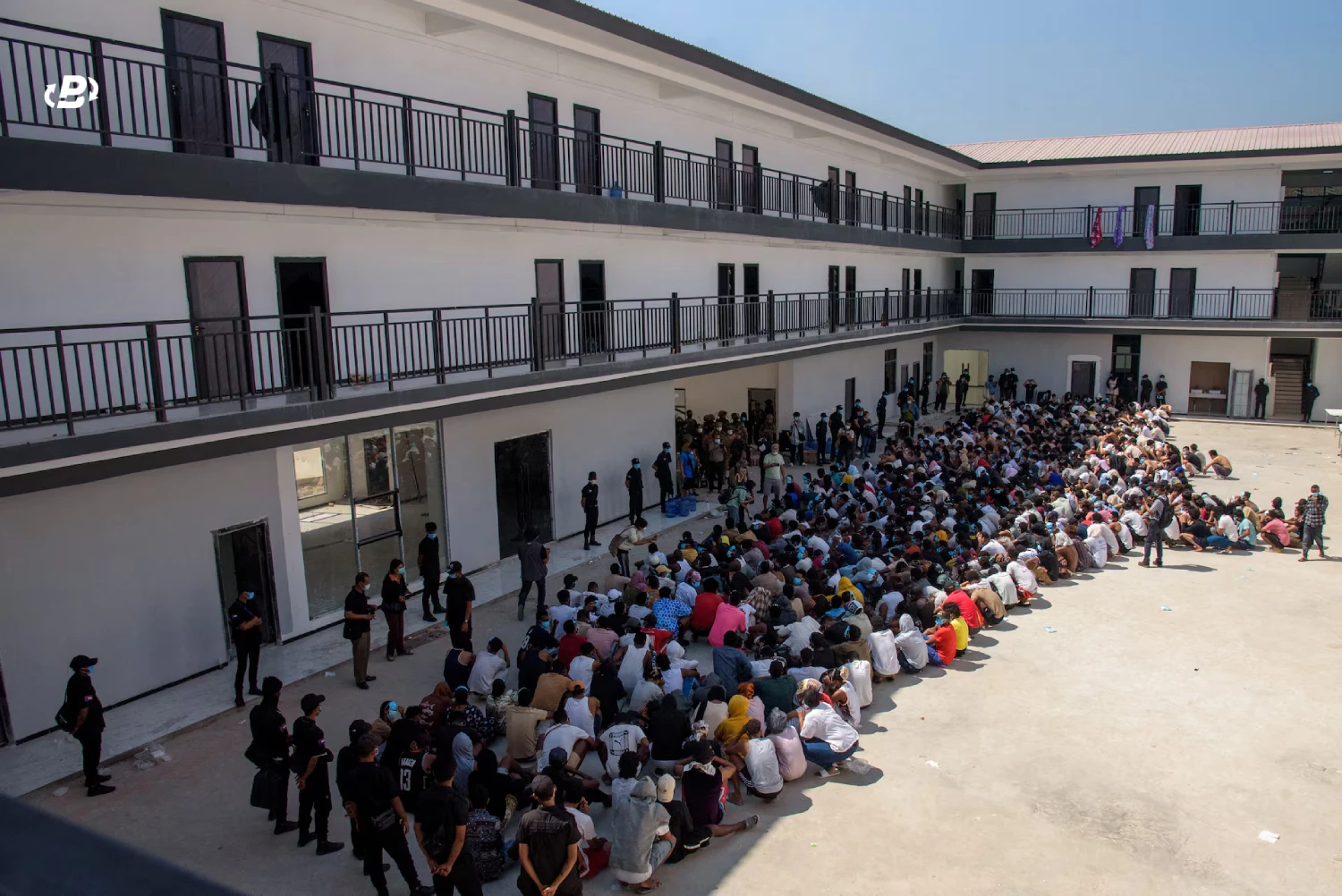
Crypto scams are growing fast, and they’re involving more and more people. In Southeast Asia, there are entire compounds operated like prisons and filled to the brim with human trafficking victims that are forced to work as crypto scammers. National Geographic recently did a video on one of those compounds, which exposed the Myawaddy pig butchering crypto scam. It's a detailed scam run by organized crime groups that work out of Myawaddy, a small city in east Myanmar, to which they attract people by offering them fake jobs with high salaries and then holding them as prisoners and forcing them to scam victims. The scammers use fake profiles to gain the trust of victims, get into romantic relationships online with them, convince them they have insider knowledge about guaranteed high-profit crypto platforms, let them invest all their life savings into the platform, and steal all their money.
How Did the Myawaddy Pig Butchering Crypto Scam Get Its Name?
I remember visiting my grandparents in the countryside as a kid in time for the pig butchering season, usually right before New Year’s Eve and Christmas. Pigs are smart and gentle giants, give them a warm shelter, connect the shelter to a small open-air pen they can roam around in, and feed them plenty of table scraps, and they’ll happily fatten up, reaching up to 500 kilograms each. When you want to kill a pig, you can’t just jump at it and start stabbing because it will panic and body slam you. But, give it scratchies behind the ear, and it will relax and happily follow you to the killing spot, where you’ll have a team ready to smack the pig on the head, quickly slit its throat, and hoist it on the rack to bleed it out. The “pig butchering” scam works exactly like that, with the scammers using advanced knowledge of human psychology to put the victim at ease, let it invest by using crypto, and financially bleed it out.
Myawaddy is the perfect place for such crypto scams because it is a small city in Myanmar, a politically unstable country. Based on my experience living in a similar country, the central government in Myanmar is weak, corruption runs rampant, the borders are leaky, mobsters rule like kings, and law enforcement serves the highest bidder. In short, if you live in Myanmar and have money, it’s like you’re playing Grand Theft Auto with cheat codes, and you can buy whatever you want and get away with any crime. Myawaddy also happens to have the ideal combination of rough terrain that prevents large-scale military invasions and diverse transport routes to allow a constant trickle of supplies into it.
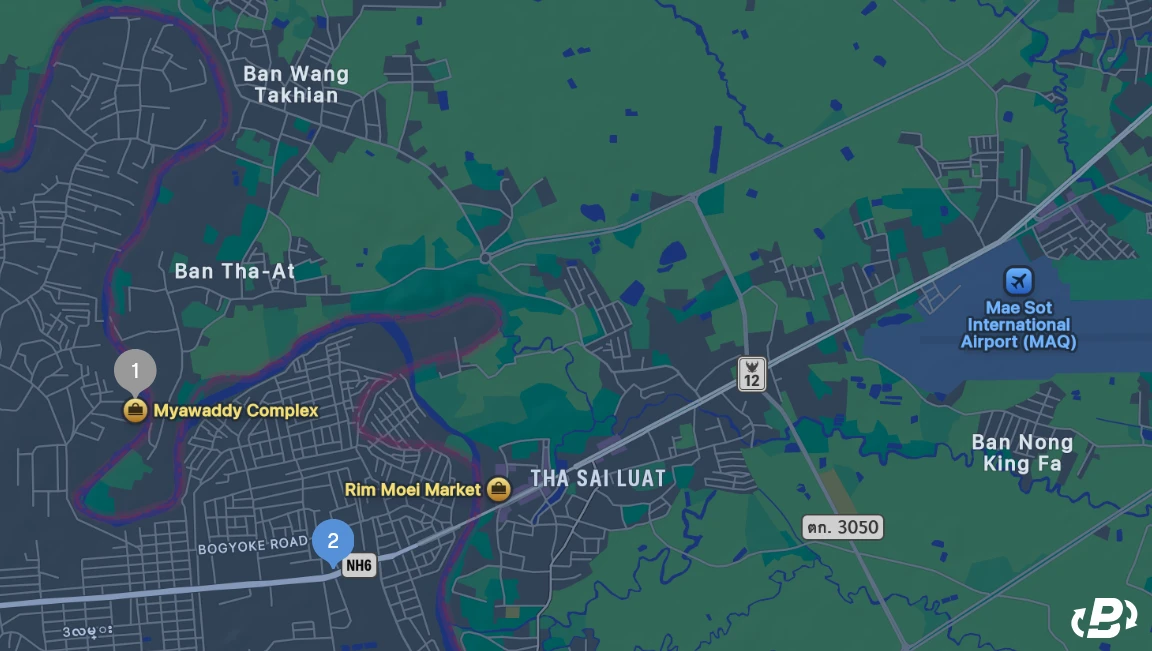
Myanmar on the left, the Moei river (blue line), the border (purple line), and Thailand on the right
Myawaddy is right next to the Thailand border that criss-crosses the winding Moei river that feeds the nearby jungle, and for a long time it was a notorious hub for sex trafficking. The place is well connected to the entire world because it has an official border crossing, the Moei river is convenient for transporting supplies and prisoners and disposing of bodies, and the Mae Sot International Airport and the Mae Sot Economic Zone are two kilometers east and across the border. I should also note that the Myawaddy Complex Casino is just a stone’s throw away, and based on Trip Advisor reviews, it appears to be a legitimate gambling establishment that, as of August 2025, is for locals only, but I suspect that’s where the money laundering of the scam proceeds takes place.
Off to the left in the above image, the roadway marked “NH6” connects to another marked “AH1,” which stands for “Asian Highway 1,” a trans-Asian highway that starts in Tokyo, spans 20,000 kilometers, and goes through Myanmar, Pakistan, India, Iran, Bangladesh, and other countries, and ends up in Turkey, where it become European Highway E80. On the other side of the Bosporus Strait, the E80 goes through Bulgaria, the Balkans, Italy, France, and Spain before ending in Lisbon, where the shipping routes allow transit to the Americas.
Thanks to this combination of transport routes, mobsters in Myawaddy pretty much have global reach and can escape anywhere they want if they feel threatened by an overwhelming armed force. However, my research showed that the Myawaddy scammers, who are connected to the Chinese Triad, will fight tooth and nail to keep control over Myawaddy and that they would rather use AH1 and E80 to pull in supplies, reinforcements, drugs, weapons, and technology such as power generators and Starlink antennas to keep their compounds running smoothly. If need be, they will start a war over Myawaddy, and they are confident that they can win it, which is why they’re digging in.
How Does the Myawaddy Pig Butchering Crypto Scam Work?
National Geographic has a running series called “Trafficked with Mariana van Zeller,” and in season 5, episode 2 of the series, Mariana investigated the Myawaddy crypto scam and interviewed Amy Miller, an employee of a Christian charity organization called “Acts of Mercy,” who says that there are dozens of Myawaddy compounds, that they are run by Chinese mafia groups, aka. the Triad, and that they have at least 120,000 prisoners, though she suspects it’s much higher because “Myanmar is a historically unstable place [with] transnational organized crime.” The scam compounds are found all around Myawaddy, with those built by the Triad that look like fortresses surrounded with 3-meter-tall walls, barbed wire, and 24/7 guards. They can be immediately recognized because of their efficient use of space that indicates a zoning plan.
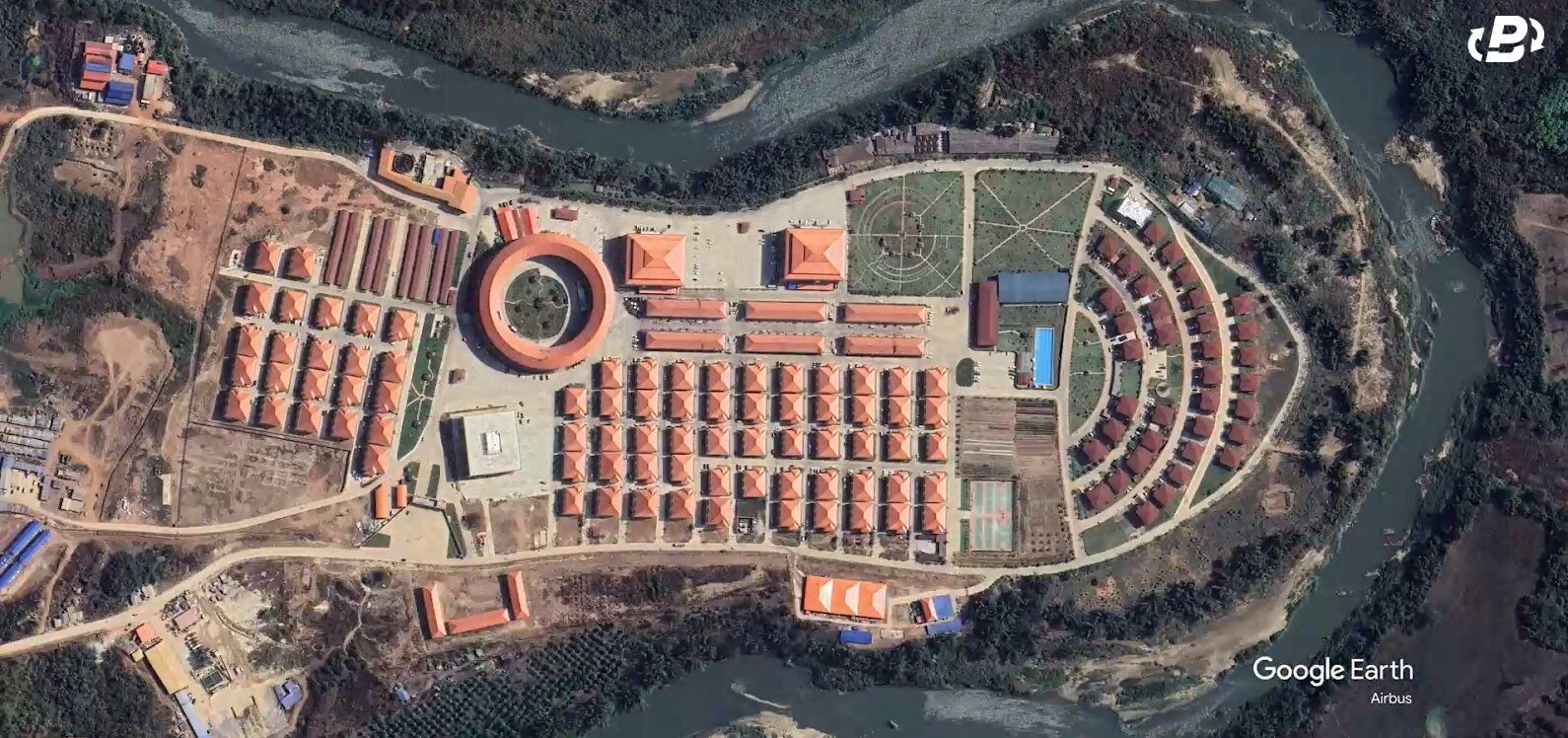
This compound is found at 16°44'54"N 98°28'34"E
Mariana also interviewed two Myawaddy scam compound workers who shared the secrets of what happens on the inside. One of them was a low-level prisoner who said that 95% of the people there were held behind bars, expected to fulfill daily quotas, and beaten on a regular basis, just like he was. If they try to escape, they are killed if caught. Another interviewee was from the other 5% who were treated like regular employees, and he was an IT expert who worked in the compound before fleeing. He explained the four steps of the scam.
Step 1, Setting the Stage
An IT expert at the compound goes through TikTok, Facebook, Instagram, and similar social media and downloads photos and videos of pretty girls dancing, posing, or just goofing around. He edits the photos and videos so that they don’t trigger spam or copyright filters and so that it’s difficult to find them by reverse image searching on the internet. Then, he uses that content to create fake profiles on other websites and apps, including those for dating, such as Tinder. The content he gathers can include pictures and videos of the girl being naked or performing sex acts.
Step 2, Contact
A low-level prisoner at the compound takes control of a fake profile and uses it to contact people whom the scammers think belong to a vulnerable group, such as single men aged 40–60, and starts a conversation. The scammers can use photos and videos of men to contact lonely older women as well. Whichever they choose, there is always a hint of a romantic relationship involved in the scam.
The first message is most often something innocent that seems to be sent to the wrong number, such as, “Are we still meeting in 10 minutes at the coffee shop?” When the target replies, “Sorry, you must have the wrong number,” the scammer apologizes and starts a conversation that follows a script. There can be multiple scammers who work on the same target.
Step 3, the Relationship
If the scammer thinks there is potential for romance, he will start love bombing the target, which is common in cults and abusive relationships and involves showering the target with praise, kindness, and intense interest, asking how the target’s day went, how the target is feeling, and so on. A typical sentence in love bombing is, “I feel like we are destined for each other.” The goal of love bombing is to get the target to feel appreciated, loved, and special so that it lowers its guard. If the scammer thinks the target is more materialistic, he will present himself as a financial advisor. The scammer regularly contacts the target, works on gaining the target’s trust, and starts dropping hints about a crypto trading platform.
Step 4, the Bait
The scammer gets the target interested in crypto trading, shows the target how to make a profile on the fake platform, how to deposit money, and how to trade, and promises huge profits. The scammers let the target play around in the sandbox for a few months, during which the cryptocurrencies show massive gains on every investment the target makes. But, none of the profits can be withdrawn because of fake transfer fees, withdrawal taxes, transfer cooldowns, ID requirements, and similar limitations. The target goes all in and gets a loan from the family, sells the house, and gets every last penny possible to put in the platform, and then comes the butchering part.
And This Little Piggy Went to the Slaughter
One Reddit user, appropriately named “SlaughteredPiggy,” shared a post in which he described how his wife wasted their life savings in the pig butchering scam. Their marriage was going through a rough period, and they didn’t speak to each other for a while. She apparently started thinking that he was going to leave her, so she started looking for financial advice and complaining about her marriage online, which to me sounds like an obvious attempt to get advice on how to steal and stash away their money before divorcing him. She quickly found a scammer (or an accomplice) who taught her how to invest by using crypto. The investment apparently quadrupled in a short while, and she started putting more and more money in, including their retirement money and the money she borrowed from the family.
When she tried to cash out, the advisor told her that she needed to pay transfer fees and taxes on the gains, which can’t be paid from the account balance, so she started putting in more and more money into the platform. By the time SlaughteredPiggy realized what was happening, his wife had already sent around $1.5 million to scammers, leaving them six figures in debt. He didn’t divorce her because, in his words, “I don’t know if I have the heart to do that, since none of this was malicious.” As the final word of warning, he said, “As soon as someone proposes any transaction in crypto, it should be a red flag.”
Other victims of the same scam interviewed by Mariana reported losing $300,000 to $1 million, and they didn’t invest it all at once, but over several months. According to the IT expert, each scam center has around 200 employees working in shifts around the clock, making the Myawaddy pig butchering crypto scam the kind of long con that is profitable for the organized crime groups that, based on the little information we have on them, are most often led by Chinese Triad mobsters who were just a few years earlier running small-scale gambling operations.
Crackdown on the Myawaddy Pig Butchering Crypto Scam
The first cases of the pig butchering scam appeared in 2018 and were exclusively involving the Chinese. The scam became a global phenomenon in 2020 with the COVID-19 pandemic and harsh restrictions on the travel of the Chinese abroad, when the Chinese mobsters that ran gambling resorts in Southeast Asia and relied on Chinese gamblers were starting to run out of visitors, so they pivoted to the pig butchering scam, perfected the scam script to more easily apply it globally, replaced their marketing teams with prisoners to lower costs, and fortified their casinos. The mobsters found that Myanmar is the perfect place for their scam, which takes time to mature, due to political instability.
In 2021, Myanmar had a coup that left the country in turmoil, creating a vacuum of power that was filled by local militias and border guard forces that control entire cities and regions, and whoever pays them the most gets to rule their region and set up a scam compound there, which is a lucrative investment. According to the United States Institute for Peace (USIP) article published in February 2025, crime syndicates operating out of South Asia, including Laos and Cambodia, are scamming Americans for at least $5 billion a year, and global losses are $64 billion a year.
The research report published by USIP in 2024 refers to the pig butchering scam by name and even mentions Myawaddy, stating that the research found victims of the scam in 99 countries. The crime groups have spread out of Asia into South America, the Middle East, and Africa, and where the government tried to crack down on scam compounds, the scammers secretly started them in casinos and hotels. In October 2025 in Cambodia, the US Department of Justice seized $15 billion in Bitcoin from a Chinese man connected to pig butchering scams, but that’s only a drop in the bucket, and the pig butchering scams don’t show any signs of slowing down.
How To Identify the Pig Butchering Scam? Use the $1 Test
The Myawaddy scammers work off of a script, and once you know the script, you can immediately recognize that you’re talking with a scammer. But, if you understand the psychology of the scammers, you can recognize any kind of similar scam or even a fake employer as long as you do some research and keep an open mind. How to identify the pig butchering scam? If someone you barely know starts talking to you and later offers you to invest in crypto platforms that can generate profits that sound too good to be true, that’s a red flag. Other red flags could be guaranteed profits or investment platforms without a license on a brand new domain, suggestions that they have exclusive knowledge about the next crypto tokens that will go up in value, and similar insider claims.
I recommend a simple $1 test that I discovered during my early freelance writing days when I met clients who asked for work and kept delaying payments. Before doing any work for a client, I would ask him to send me $1 to see if he has any money and a working payment channel, and if he refused with any kind of excuse, I knew I wasn’t going to get paid at all and that the client would use the same excuse when it came time to pay me for my work.
If you’re considering working abroad, tell your friends and family about it. Ask the employer to pay you at least $1 in advance so that you know he has money and can pay you at all. If you get imprisoned by the employer and your friends and family contact the police, they will first check your bank accounts, see the $1 transaction, and have some information on who sent it and where you went. That $1 could save your life.
You can use the $1 test on any trading platform. If you can’t withdraw $1 of your money from the platform, there is a good chance you won’t be able to withdraw any amount above it. Even if the platform turns out to be a scam but you managed to withdraw $1, you will have some information on the scammers’ bank account that might help you get your money back. Banking is very difficult for scammers because they are constantly being shut down by banks, so they use a complicated web of cryptocurrency wallets to receive money. Scammers are very careful about giving the details of their actual bank accounts that they use to send money to others, so if you have any information about those accounts, you might be able to get your money back and hurt the scammers.
Also, be wary of those who are too forward and too revealing online. There are people who are very friendly online and who like chatting, sending photos of their cats, dogs, birds, a new haircut, and so on, and they can be great friends, but they are not the same as people who overshare with the purpose of manipulating you by sending sexy pictures and videos when you didn’t ask for them and the conversation didn’t lead up to the topic. One Australian study done in 2017 and titled "Sending Nudes: Sex, Self-Rated Mate Value, and Trait Machiavellianism Predict Sending Unsolicited Explicit Images" found that people who send sexy pictures of themselves, including dick pics, to those who didn’t ask for them are very likely to be manipulators and psychopaths. Just to be safe, I would also apply that to people who brag about and send you pictures of their wealth. If someone is showing you their money, cars, houses, watches, gold coins, etc. when you didn’t ask to see them and the conversation didn’t lead up to it, you’re certainly dealing with someone who feels the need to flex on others and who could also be a scammer.
What Are Myawaddy Scam Centers? Literal Prisons with Hundreds of Scammers
The Chinese mobsters put their knowledge of running casinos to use by having prisoners that work 17-hour shifts to scam people out of their money, but they needed more space than their casinos allowed, so they started making entire compounds from the ground up. Myawaddy gained global recognition because of those compounds that attracted investigators to figure out what was happening in these strange buildings that started popping up by the dozens. What are Myawaddy scam centers? They are barricaded compounds in the Myawaddy township of Myanmar, next to the Thailand border, that are run by organized crime that lures people with fake job offers just to attract them and then force them to work as scammers in the so-called “pig butchering scam" to steal money from victims, and if they refuse scamming, they are beaten, tortured and abused.
Despite continued rescue and awareness efforts, the number of Myawaddy prisoners keeps increasing. The mobsters most often get new prisoners by posting fake job posts for IT tech support roles in the Mae Sot Economic Zone, kidnapping the people who land in the Mae Sot airport, and moving them to Myawaddy through the jungle. In February 2025, almost 9,000 people were released from Myanmar compounds, including 700 Africans, such as Kenyans and Ugandans, but also Indians. One of the rescued prisoners, a Chinese from the Yunnan province, said he was kidnapped when he came to Mae Sot looking for work, trafficked across the border, sold to a Myawaddy scam compound for $20,000, and beaten with whips because he couldn’t type fast enough with a deformed finger. He was later resold to other compounds, where he made initial contact with potential victims before passing them on to other prisoners.
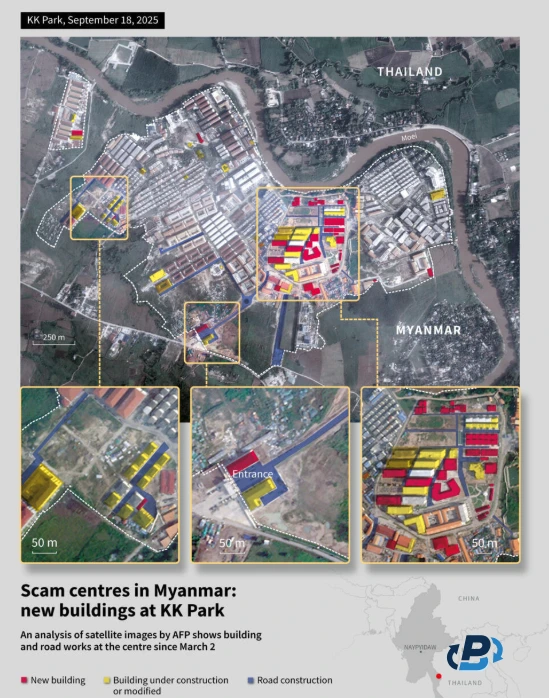
A scam compound south of Myawaddy, found at 16°38'48"N 98°31'14"E
Meanwhile, the construction and development of new scam compounds is booming. Satellite imagery shows that one of them, KK Park, is getting new roads and new dormitories, and the surveillance photos by investigators show up to 80 Starlink dishes for internet connectivity. Thailand started cutting off power and internet connections to Myawaddy, but the mobsters kept building, and KK Park now allegedly has a hospital where organ harvesting takes place, a supermarket, and restaurants for high-level IT experts and programmers who are treated as regular workers, hired under a contract, and paid a salary. The July 2023 estimate by USIP states that KK Park is operated by around 20,000 people.
PlasBit’s Role in Exposing The Myawaddy Scam
I had a chat on this topic with the boys at PlasBit, and we decided that this article deserves at least one sequel that will reveal the true scale of the problem. There is so much going on in Myawaddy, which seems like a tiny city in the middle of nowhere, but I think it is quickly becoming the center for global scamming that will sooner or later affect all of us, especially since China is getting increasingly involved in cross-border attacks on its citizens running the scam, and we could all be caught in the crossfire. The main reason why PlasBit was founded was to push back against such crypto scams and scammers that hurt all of us and tarnish the good name of cryptocurrencies so that we can hopefully contribute to creating an indestructible and incorruptible cryptocurrency ecosystem that doesn’t involve human trafficking and organized crime.